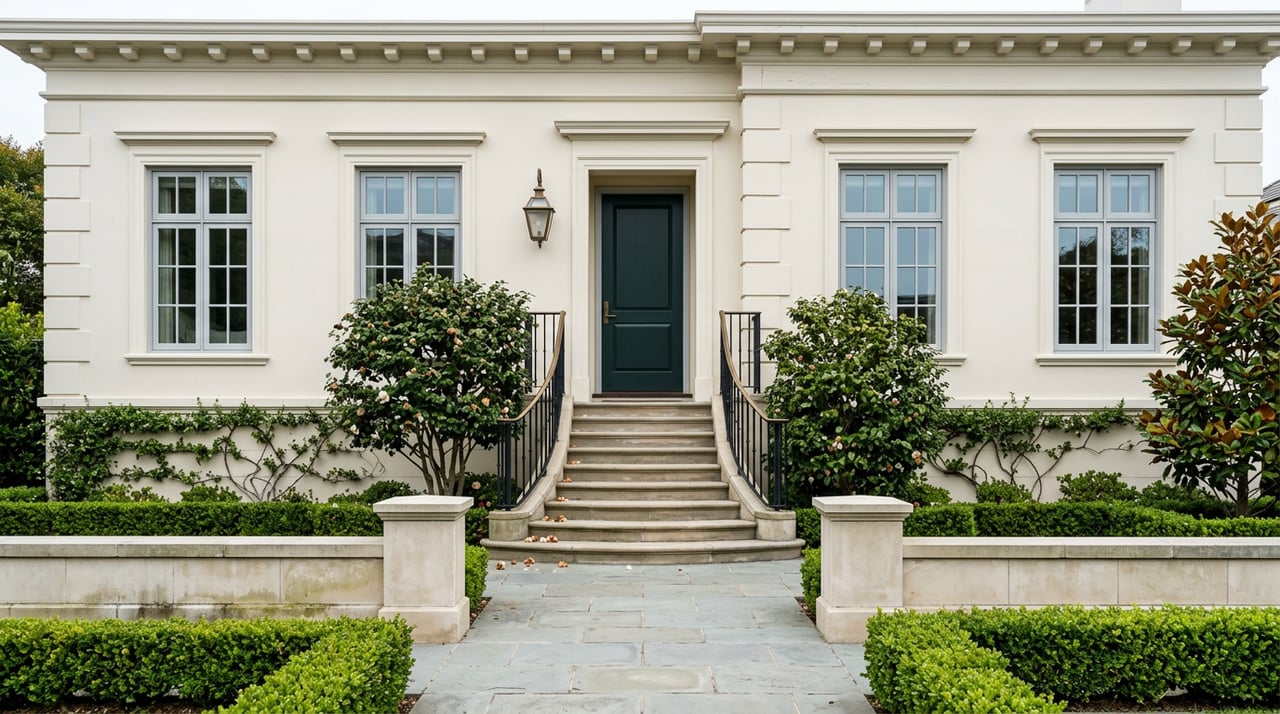
Why Pacific Heights Sellers Watch $10 Million and $25 Million So Closely
August 20, 2026
August 20, 2026
A six-bedroom Georgian Colonial at 2830 Pacific Avenue first listed in 2023 for $35 million. After a price cut to $27.5 million in the spring of 2025 gave it what one agent called a "fresh start," it finally closed at that price in late April 2026. A few blocks away, the Perry House at 2606 Jackson Street listed for $22.5 million in April 2026 and drew multiple offers within weeks, landing at $24 million. Both are Pacific Heights mansions. Both sold within months of each other in a market Compass agent Nina Hatvany described as one where comparable sales are "meaningless." Yet one seller ended up on the far side of a line that cost real money to cross, and the other stopped just short of it.
That line is not a matter of taste or timing. It is San Francisco's transfer tax schedule, and it does not rise gently as sale prices climb. It jumps.
Most California counties charge a flat documentary transfer tax of $1.10 per $1,000 of sale price, regardless of what the home is worth. San Francisco does something different. Above $10 million, the rate jumps to 5.5 percent. Above $25 million, it jumps again to 6 percent. Those rates trace back to Proposition I, which San Francisco voters passed in 2020 with 58 percent support, specifically to raise money from the city's highest-value sales.
The part that catches people off guard is not the existence of tiers. It is how the tiers apply. San Francisco does not tax only the portion of a sale price that falls above each threshold, the way federal income tax brackets work. It taxes the entire sale price at whichever rate that price falls into. A $24,999,999 sale is taxed at 5.5 percent on the whole amount. A $25,000,001 sale is taxed at 6 percent on the whole amount. The difference between those two numbers is two dollars. The difference in tax owed is real money, and on residential sales it is customarily the seller who pays it at close of escrow.
Run the math on a sale like 2830 Pacific Avenue's $27.5 million close. At the 6 percent rate that applies above $25 million, the transfer tax on that price comes to roughly $1.65 million. Had the identical closing price landed at $24,999,999 instead, two dollars on the other side of the line, the whole amount would have been taxed at 5.5 percent, a bill closer to $1.375 million. That is roughly $275,000 riding on two dollars of sale price, not because the home is worth more or less, but because of which side of a threshold the number falls on. That is not a rounding error. That is a line item a seller's advisor should be walking through before an offer is ever accepted, not after.
Look at how 2026's Pacific Heights closings actually lined up against these thresholds, and the pattern becomes hard to miss.
2606 Jackson Street, the Perry House, sold May 8, 2026 for $24 million after listing April 13 at $22.5 million. Designed in 2002 by the late architect Olle Lundberg on a double lot overlooking Alta Plaza Park, it sold to an entity called 2606 Jackson LLC after multiple offers pushed the price $1.5 million above asking. Whatever calculation the sellers, retired venture capitalist Mark Perry and his wife Mauree Jane Perry, made when they set that $22.5 million ask, the final number stayed comfortably under the $25 million line.
2830 Pacific Avenue closed the opposite way. Listed in 2023 for $35 million, cut to $27.5 million for a "fresh start" according to Compass agent Max Armour, and sold at that full asking price after a year on the market. Seller Rajiv Ghatalia, president of Hennessey Capital, had purchased the Georgian Colonial in 2010 for $8.4 million and was downsizing after his children moved out. The sale, at more than $2,800 per square foot, crossed the $25 million threshold by $2.5 million, meaning the entire sale price was taxed at the top 6 percent rate rather than 5.5 percent.
3140 Pacific Avenue shows what happens near the lower cliff. The home sits along the wall of the Presidio, at the edge where Pacific Heights meets Presidio Heights, and Sotheby's agent Janet Schindler listed it for $7.5 million in late June 2026, telling sellers Sean and Anne Eu Warren that if they weren't comfortable with that number, they shouldn't list at it. Within a month it drew half a dozen offers and closed July 22, 2026 at $12 million, 60 percent over asking, the widest list-to-sale gap in the neighborhood that year. That final number sits well above the $10 million threshold, meaning the seller's tax bill was calculated at the 5.5 percent tier rather than the lower rate that applies below $10 million.
2898 Vallejo Street, the Beaux-Arts mansion tied to the Alioto family and once used as a filming location for The Towering Inferno, sold off-market in April 2026 for $56 million to an entity called Granola Properties LLC. Seller Daniel Alegre, the TelevisaUnivision CEO and former Google executive, had purchased the home in 2013 for $11.7 million. At $56 million, the sale sits deep in the top tier no matter how you slice it, making it San Francisco's priciest residential closing since 2024.
Four sales, four very different relationships to the same two numbers. None of this is coincidence. It is what happens when a market moves fast enough, and prices high enough, that the tax code itself becomes part of the negotiation.
For a few months in 2026, Pacific Heights sellers had reason to think these cliffs might soften. In February, Mayor Daniel Lurie and District 5 Supervisor Bilal Mahmood introduced the BUILD Act, a proposal to cut the $10 million to $25 million rate from 5.5 percent back down to 2.75 percent, and the $25 million-plus rate from 6 percent to 3 percent, restoring the pre-Prop I rates through ordinance rather than a ballot vote. The pitch was that lower transfer taxes would unstick roughly 50,000 entitled but unbuilt housing units across the city.
The city's own Controller's Office estimated the cut would cost the general fund close to $390 million over four years. With San Francisco facing a projected $643 million two-year budget deficit and city staff layoffs already underway, the numbers proved hard to defend. In June 2026, Mahmood put the BUILD Act on hold, saying he would not move forward without a way to make it revenue neutral, a promise tied to a companion measure taxing certain foreclosure transfers that is now headed to the November 2026 ballot instead.
What this means for anyone transacting in Pacific Heights right now is straightforward. The 5.5 percent and 6 percent rates that shaped the 2830 Pacific Avenue and 3140 Pacific Avenue sales are not a temporary quirk waiting to be repealed. They are the operative law, and the political effort to change them has stalled with no clear timeline for revival. Planning around a rate cut that might arrive next year is planning around a bill that currently has no path to a vote.
None of this changes what a Pacific Heights home is worth. It changes when a seller decides to accept an offer, and how a buyer's agent frames a number that sits close to $10 million or $25 million. A seller sitting at $24.6 million with an offer at $25.2 million is not just weighing $600,000 in additional proceeds. They are weighing whether that gain is worth roughly half a point in additional transfer tax applied to the entire price, a calculation that only becomes visible when someone runs it before the offer is signed, not after it closes.
This is also part of why comparing a Pacific Heights closing to a similar sale in Marin or the Peninsula misses something important. Those counties charge the flat $1.10-per-$1,000 rate no matter the price. San Francisco's tiered structure exists only inside the city, which means the total cost of a high-end sale here carries a variable that a nearly identical home ten miles away simply does not have.
None of this is tax advice, and the exact figure on any closing statement should come from an escrow officer working from the current San Francisco Treasurer and Tax Collector schedule, since rates and exemptions can shift with future legislation. What it does mean is that a serious pricing conversation for anything approaching these thresholds needs to happen before a listing goes live, not after an offer arrives.
Does the transfer tax cliff apply to every sale, or only above a certain price? The tiered rates only become material at higher price points. Most San Francisco home sales fall well below $10 million and are taxed at lower tiers that rise gradually rather than jumping.
Who actually pays the transfer tax in San Francisco? By local custom, the seller pays it on residential sales, though this is negotiable in the purchase agreement and occasionally shared or shifted to the buyer in competitive situations.
Could the rates change again soon? The BUILD Act's proposed cuts are on hold with no scheduled vote, while a separate ballot measure affecting foreclosure exemptions is headed to San Francisco voters in November 2026. Anyone pricing a sale near $10 million or $25 million this year should plan around the rates currently in effect, not a possible future change.
If you are weighing a sale or purchase anywhere near these thresholds in Pacific Heights, the pricing conversation is worth having with someone who tracks both the comparable sales and the tax mechanics behind them. Steve Giannone works with Pacific Heights buyers and sellers on exactly this kind of math. Schedule a strategy call before you set a number.
Stay up to date on the latest real estate trends.
Get expert guidance tailored to your goals—whether you're buying, selling, or investing. Let's map out your next move with clarity and confidence.